
Benito Bowl: Perreo, Tokenizing and Easy Recipes for “Liberation”
Para leer la versión en español de este artículo presione aquí.
This is where I speak from – this is what I speak about:
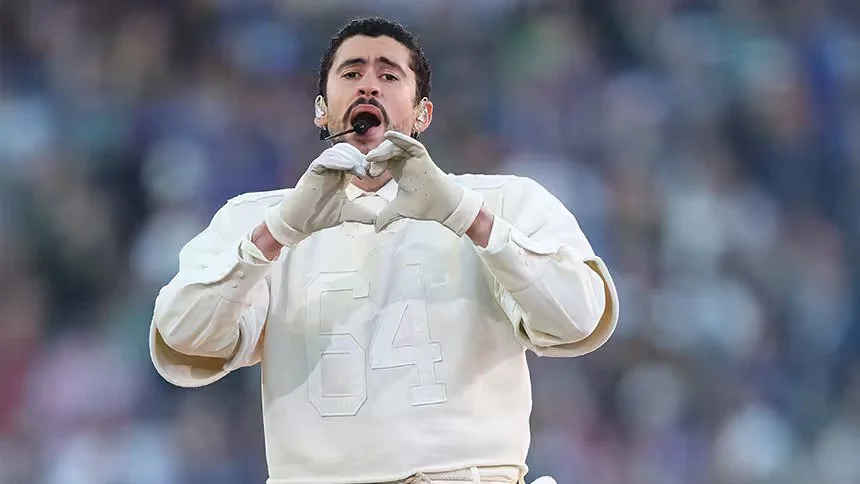
When Benito appeared on stage to the sound of Tití me preguntó, I was overwhelmed.[i] Truly. So much so that I could not immediately put into words everything that happened. After a week of reflection and conversation I decided to write. In this short article I interpret some things that caught my attention during Benito’s Super Bowl halftime show. To do so, I, first offer a brief play-by-play of the show to highlight and comment on some critical instances that I personally find interesting. Then, I turn to the danger of adopting selective aspects of Benito in ways that reproduce empty and simplistic discourses of unity, solidarity, and togetherness.
I acknowledge that some aspects of my own analysis deserve fuller attention. My comments reflect my own understanding of certain images and elements from my perspective as a Puerto Rican. This means that my words also carry emotional baggage. I am responding to an event that struck very profound cultural, corporeal and emotional dimensions of my own conflicting and ever-changing identities. I say this because, my intention is not to provide a complete and unquestionable understanding of all that took place during those fourteen minutes. My remarks here are meant as conversation-starters that I hope generate spaces for collective reflecting and thinking.
A Sugarcane Maze of Culture:
Sugarcane cutters, machete in hand and dressed as jíbaros, blended with a couple in the midst of their bella crisis (pun intended)[ii] at the door of Benito’s now-iconic casita. From there, the parade moves through a sugarcane maze, past the cold coconuts people sell on the roadside along Road #2 in Puerto Rico when they drive up the island’s northern coast. Xander Zayas fighting Emiliano Vargas, evoking the battles between Héctor “Macho” Camacho and Julio César Chavez; Félix “Tito” Trinidad and Oscar de la Hoya; Miguel Cotto and Antonio Margarito – including both the cheating scandal and the sweet vengeance. We see older men playing dominoes while women do their nails. Benito displays Puerto Rican and Latin-American culture, but most importantly, the Puerto Rican working class, the ghettos, the barrios y caseríos. The places that gave birth to reguetón.
The Casita, Perreo, and Symbols:
From the roof of the casita, he performs Yo perreo sola. In the 1990s when I was in middle school, perreo was called culeo, referring precisely to the movement of el culo.[iii] Benito perrea in la casita and sings his sexually explicit verse from the song Safaera. Again invoking his homeland, he claims Puerto Rico as the birthplace of perreo.[iv] And then, cataplum—Benito falls into the casita as the roof collapses, just as so many collapsed during and after Hurricane María in 2017.
The transition from the roof to the interior of the casita is a work of art, especially because, if you look closely, the inside almost resembles a migrant shelter. Benito stands up and kicks the door—much like ICE agents kick down doors in the United States, or Israeli soldiers kick down doors in Palestine. Unlike those who kick to invade, Benito kicks to expand. He steps into a sea of people dancing and celebrating. From there, the show takes on a life of its own: more perreo, a wedding, salsa dancers, and even Lady Gaga—whose presence carries its own tensions, as many have criticized her silence regarding the genocide in Palestine and her past support of Israel. Baile Inolvidable and Nuevayol decorate the night as it moves toward its climax.
Honoring Those Who Paved the Way—and América:
The Puerto Rican cuatro appears, and with it, Ricky Martin. This is no small thing. Ricky—as Boricuas affectionately call him—is perhaps the most important Latin American artist in the entertainment world. His career exploded globally with La Copa de la Vida, the official song of the 1998 World Cup in France. Yet long before that—through his performances with Menudo and hits like Fuego contra fuego, El amor de mi vida, and the album A medio vivir—Ricky already held a particular place in the island’s artistic and cultural history.
The song Lo que le pasó a Hawaii, which he performs, mirrors his own artistic trajectory. When he appeared at the 1999 Grammys singing half in English and half in Spanish, accompanied by trumpets, panderos, and drums, Ricky changed the rules of the game. He became a global star. His song Livin’ la Vida Loca reached the top 20 in at least 15 countries, including the United Kingdom (#1), Australia (#1), Germany, Belgium, Italy, Sweden, among many others. Ricky opened doors for Latino/a artists fighting against an industry that insisted they had to sing in English to matter. He never abandoned his romantic ballads, nor did he hesitate to represent his Puerto Rican identity. He endured questions about his sexuality at a time when wearing a skirt as a man or admitting you were gay was not well received. The world tried to strip him of his río, his playa, his barrio, and his identity. Yet he showed maña y cría, like el Josco in Abelardo Díaz Alfaro’s iconic short story.
With El Apagón and the sky-blue monoestrellada in hand, Benito offers his second shout-out to Tego Calderón. This, too, is no small gesture. DTmF—Benito’s most recent album—is a musical jewel that reflects a particular culture and experience. Still, I believe it is impossible to listen to it and not return to El Abayarde, Tego’s landmark album that redefined the genre and remains, for many (myself included), the greatest reguetón album ever. Songs like Loíza fused reguetón and bomba in a clear denunciation of racism and colonialism at a time when the genre was not yet thinking in those terms. It was Tego who first denounced “those niches who think they are better… because they have the features of their oppressors.” Through these gestures, Benito honors Ricky, who opened doors for Latino/a artists, and Tego, who gifted him his flow.[v]
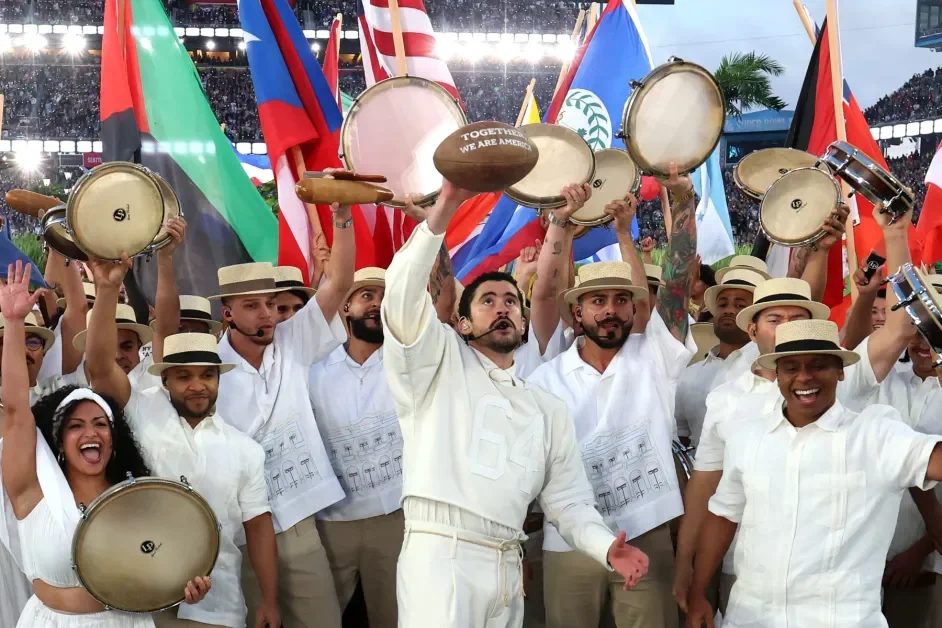
The performance closes with Café con Ron and a “God Bless América,” followed by the names of many of the countries in the continent. There is also a subtle yet powerful—intentional or not—separation between the United States and Puerto Rico by placing Canadá between them.
Beyond “ICE Out” and Anti-Trump Discourse—Let’s Keep It Real:
Benito’s show generated widespread discussion. Yet I see a growing number of analyses that ignore essential aspects of Benito’s album and halftime show. The way more and more people center his performance exclusively around anti-ICE and anti-Trump campaigns, while ignoring central elements of his music and message, reflects how privilege sometimes tokenizes historically oppressed peoples to sustain narratives of oppression.[vi] Put plainly: some celebrate the parts of Benito that are convenient, as long as they do not have to interrogate their own complicity in colonial, racial, oppressive, and genocidal processes.[vii] Others interpret Benito exclusively through Anglo–North American Western-European epistemological lenses that reproduce U.S.-centric racial debates without attending to the island’s specific colonial and racial dynamics. One example was a widely misinformed and problematic critique accusing him of “whitening” Puerto Rican bomba—something that Puerto Rican social media influencer Paola del Mar, among others, addressed succinctly.
Regarding the cherry-picking of discourse, Puerto Rican decolonial thinker Nelson Maldonado, for example, comments that “‘ICE out’ is not complete without saying ‘Free Palestine.’” Not to minimize Benito’s support for migrants, but to reiterate that “we must keep walking to create collectives that together say: ICE out, Abolish ICE, Free Palestine, Black Lives Matter, Black Power, end the blockade of Cuba, etc.” Maldonado’s words underscore the inevitable intersections within liberation discourses that name diverse mechanisms of imperial and colonial powers not only to confront them, but also to expose our own complicity in these very structures. As I argue below, attending to these complexities helps clarify, in the context of Benito and the Super Bowl, that there can be no “together we are América” without the decolonization of Puerto Rico, the end of the Cuban blockade, and the cessation of U.S. military interventions in Latin America and the Caribbean. All of these mechanisms are embedded within a colonial underlying structure that must be addressed at its root.[viii]
At this juncture, it is crucial to understand that Benito’s performance – and specifically his last album – is a profound critique of colonization and the exploitation of Puerto Rico. Chicana scholar Gloria Anzaldúa, in speaking about colonialism forcefully stated: “the essence of colonization: rip off a culture then regurgitate its white version to the natives.”[ix] Thus, statements such as “Benito is an American citizen” and “Puerto Rico is part of the USA” reveal at least a dual problem. First, “being part of” is not the same as “being property of.” In this specific context, historian Jorell Meléndez-Badillo writes that “on December 11, 1898, the Treaty of Paris formally ended the war. Puerto Rico became a colonial possession of the nascent U.S empire.”[x] To say that Benito—and by extension Puerto Rico—is part of the United States assumes a relationship of equality. But the Puerto Rico–USA relationship is not one of equality; it is one of exploitation. Second, such comments ignore that Benito’s music constitutes a proud reproduction of a Caribbean culture that has been minimized and racialized for centuries. Benito does not simply sing in Spanish; he sings in Caribbean-Puerto Rican Spanish. In a Boricua accent—the one mocked even within Latino circles with tired jokes about “PueLto Lico.”[xi]
Adopting Benito’s criticism, without questioning one’s own participation in the exploitation and plunder of the island about which he sings, is an incomplete task. Let me be clear, his critiques of the U.S. president, ICE, support for immigrants, and call for unity in America are vital and necessary. It is indeed beautiful to see him use his platform to speak about such things. But the matter runs deeper. He is profoundly concerned with the island’s colonial status and the United States insistence on stripping it of its culture, music, and flag.[xii] Thus, in Benito’s case, saying “together we are América” requires understanding that togetherness cannot exist while the United States exploits Puerto Rico, Cuba, Latin America, its resources, and its people because liberation is collective, not individual. Similarly, América cannot stand together in unity while some of its nations ignore and endorse a genocide taking place right in front of their eyes. I believe that Benito’s “together we are América” demands a more critical gaze that does not reduce his idea to the naming of countries on a stage. As John warned people in Revelation, our commitment to justice cannot be partial (Revelation 3:15–16).
The only thing more powerful than hate is love:
Let me be clear about one thing: the Benito Bowl was about love. He spoke about trumping hate (pun intended). With his performance he showed the power of community and collective actions. Love was at the heart of his show. And that is precisely why I point to the forgotten or ignored elements in his discourse. Because love does not exploit, does not support genocide, does not invade nations, kidnaps their presidents, bombs their people, colonizes their territories, or establishes blockades to force countries to act a certain way. Love does not kneel on people’s necks or arrests and shoots their citizens because of their skin color or because they are unsure of their immigration status. Benito’s show is about love, but a love incapable of ignoring the colonial, racial and oppressive conditions that permeate the América he sings of. His love is not an easy recipe for liberation, but a commitment to the struggle for justice, peace and dignity. Puerto Rican theologian Luis Rivera Pagán said it best when he stated that “love for the poor entails rebellion against those who exploit them.”[xiii]
Finally, we must remember that Benito is an artist. He is not a political officeholder, nor the leader of a global revolution poised to dismantle colonial structures. He is not the first—and will not be the last—to say these things. Yet from his art we can extract positive elements, critique problematic ones, and build communities that embrace the collective as a fundamental dimension of liberation for oppressed and undervalued peoples in Puerto Rico, Cuba, Palestine, Latin America, and the rest of the world.
—————————————————————————————————————————————————————————————————————-
[i] If you have not yet watched Bad Bunny’s presentation, please do so before you continue reading. Also, in this article, I will refer to Bad Bunny as Benito.
[ii] Videos have surfaced critiquing the mistranslation of “bella crisis” to beautiful crisis.
[iii] Literally: the ass.
[iv] In a remix of the song Carolina, recorded in the early 2000s, reggaetón artist Julio Voltio claimed Carolina as the place where perreo was invented.
[v] In the song Nadie Sabe, Benito states, “I owe my flow to God and Tego Calde.”
[vi] See, for example: https://mralancooper.medium.com/the-bad-bunny-halftime-show-deecb37b1a4f
[vii] See, for example: https://www.vox.com/culture/478687/bad-bunny-super-bowl-halftime-show-woke-vibe-shift-republican-backlash
[viii] Aníbal Quijano first called this the colonial pattern of power.
[ix] Gloria Anzaldúa, Light in the Dark=Luz En Lo Oscuro: Rewriting Identity, Spirituality, Reality, ed. AnaLouise Keating (Duke University Press, 2015), 48.
[x] Jorell Meléndez-Badillo, Puerto Rico: A National History (Princeton University Press, 2024), 66.
[xi] In his song Nadie sabe, Benito states: “I finish them with ‘L’ because they sound weird with ‘R’,” alluding to Boricua slang and particular modes of pronunciation. Also, in LA MuDANZA on his most recent album, he affirms the use of a distinct Puerto Rican vernacular.
[xii] In LA MuDANZA, he also reminds us of the Gag Law, passed in 1948, which prohibited, among other things, the public display of the Puerto Rican flag in the island.
[xiii] Luis N. Rivera Pagán, Senderos Teológicos: El Pensamiento Evangélico Puertorriqueño (Editorial La Reforma, 1989), 136. Translation mine.